
English| EUR
Suggested for you
More currencies
Choose a language
Húsavík sits on the western shore of Skjálfandi Bay, a 50-kilometre-wide inlet that functions as a year-round feeding ground for humpback whales, minke whales, white-beaked dolphins, and harbour porpoises. All whale-watching tours depart from the harbour at Hafnarstétt, a compact marina within walking distance of the town centre. This guide explains where to board, what the bay offers, and how the touring rhythm works.
Quick answer
All whale-watching tours in Húsavík depart from the harbour at Hafnarstétt, 640 Húsavík, accessible seven days a week from 07:00 to 22:00. The harbour serves as the sole embarkation point for tours into Skjálfandi Bay, where year-round cetacean populations include humpback whales, minke whales, white-beaked dolphins, and harbour porpoises. Early morning departures often coincide with calmer seas and softer light for photography.
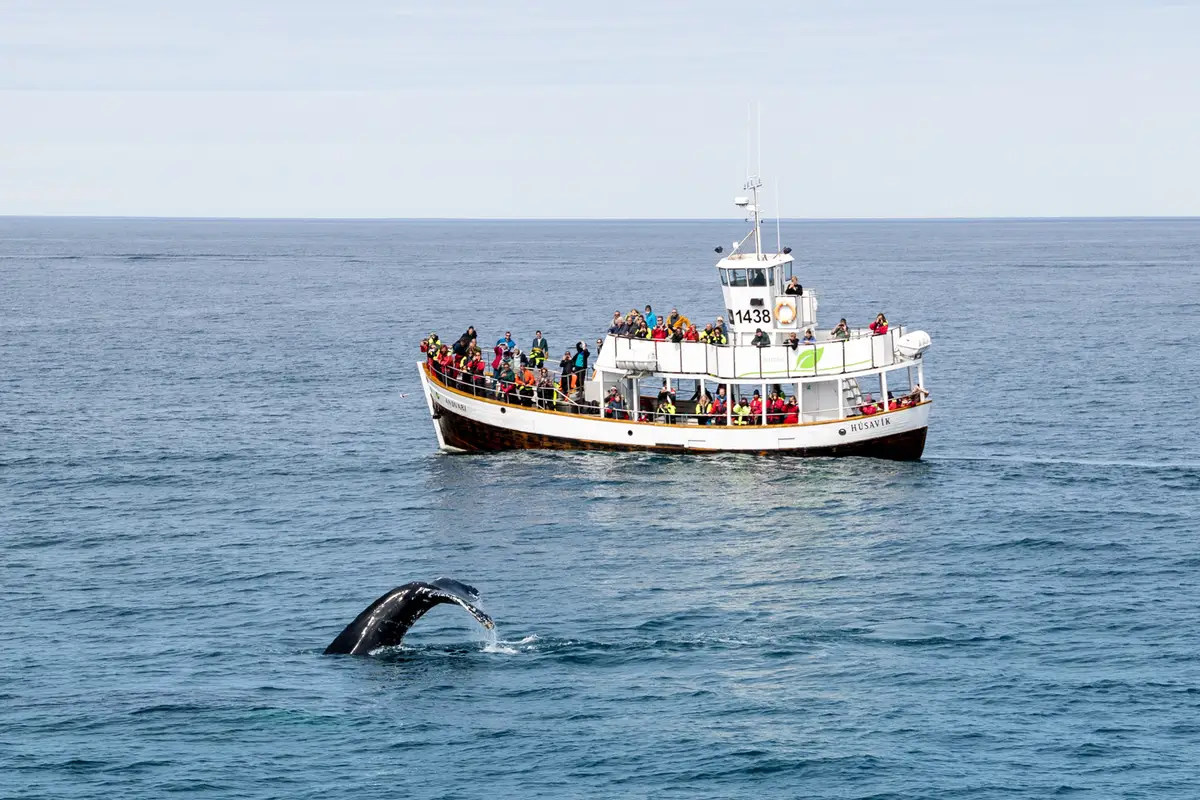
Skjálfandi Bay holds one of Iceland's highest densities of cetacean sightings per square nautical mile, a statistic attributed to the bay's cold upwellings that concentrate krill, capelin, and herring near the surface. Húsavík operates as the gateway settlement, a fishing village of fewer than 3,000 residents that now sends more than a dozen vessels into the bay each day during peak season. Where can i go for whale watching depends on your departure point, and in Húsavík that point is singular: the harbour at Hafnarstétt. The pier system accommodates traditional oak boats, rigid-hull inflatables, and converted fishing trawlers, all berthed within a 200-metre stretch of the waterfront. North Sailing, the harbour's longest-operating outfit, maintains its ticket office and boarding gate at the eastern end of the quay. No shuttle or secondary dock exists; passengers walk directly from the harbour apron onto the vessels. Humpback whales arrive in Skjálfandi Bay each April and remain through October, their presence overlapping with minke whale residency that extends year-round. White-beaked dolphins appear in pods of six to twenty individuals, often bow-riding beside slower vessels. Harbour porpoises, the bay's smallest cetaceans, surface briefly and require calm conditions to spot. Blue whales pass through the bay's outer reaches in June and July but remain rare compared to humpbacks, which breach, tail-slap, and lunge-feed in full view of tour groups. The harbour's open access—entry to the pier area is free—means visitors can walk the waterfront, inspect the fleet, and speak with crew members before committing to a departure. Early morning tours between 07:00 and 10:00 benefit from lower wind speeds and the bay's morning light, which renders the water surface glassy and improves visibility for spotting dorsal fins and blows. Afternoon tours encounter more active feeding behaviour as fish schools rise toward warmer surface layers, though sea state becomes choppier as the day progresses. Whale watching in Húsavík is a location-specific activity: the species composition, harbour infrastructure, and tour frequency are shaped by Skjálfandi Bay's bathymetry and the settlement's proximity to deep water. The bay's 200-metre contour lies less than five nautical miles from the harbour mouth, allowing vessels to reach prime cetacean habitat within twenty minutes of departure.
“Skjálfandi Bay holds one of Iceland's highest densities of cetacean sightings per square nautical mile, a statistic attributed to cold upwellings that concentrate prey near the surface.”
The peak season for whale watching in Húsavík occurs from June to August, when marine life is most active in Skjálfandi Bay. Early morning tours are recommended for calmer sea conditions and softer light.
Mild, 8°C to 14°C
The primary season with frequent sightings of humpback and blue whales. Many species remain in the bay for feeding.
Cooler, 3°C to 10°C
Transition months offer fewer crowds while maintaining high probabilities for spotting cetaceans. Puffin activity often tapers off by late August.
—
Early tours frequently encounter flatter water and lower vessel traffic. This timing provides stable conditions for photography and observation.
Verdict: The best time for whale watching is between June and August, specifically choosing early morning departures on weekdays.
Whale watching tours depart from Húsavík Harbour, located at Hafnarstétt, 640 Húsavík. The harbour area is centrally located within the town and is easily accessible by vehicle or on foot.
Route 85 to Húsavík
Strætó Route 79 to Húsavík
Follow Hafnarstétt toward the waterfront
Public parking is available near the harbour area at Hafnarstétt. Once you arrive, proceed to the harbour front where tour operators are stationed.
The facility is open daily to assist with departures and inquiries. Visitors may access the harbour area and information services throughout the week.
Access to the Húsavík harbour area is free of charge for all visitors. Whale watching tours require separate bookings, with costs determined by the specific operator and tour type.
Verdict: While harbour access is free, individual tour costs vary based on the provider and vessel selected.
Whale watching from Húsavík requires advance booking and preparation for North Atlantic conditions.
Everything you need to know about where can i go for whale watching
Húsavík is widely recognized as the capital of this activity in Iceland, offering a unique opportunity to witness marine giants in their natural habitat. Many travelers ask where can i go for whale watching to find reliable service and knowledgeable local guides.
The harbor area serves as the central hub for your Húsavík whale and puffin tour adventure. Numerous departures are available from this location to facilitate your journey into Skjálfandi Bay.
The best arrival window is 07:00–21:00 to ensure you have ample time to reach the harbor. Early morning departures often offer calmer seas and softer light for photography.
There is 0 ISK entrance fee to the harbor area itself. Please note that all whale watching tours require a separate paid booking to secure your spot on a vessel.
If you are wondering where can i go for whale watching with expert crew, the harbor at Hafnarstétt, 640 Húsavík, is your primary destination. This location provides direct access to vessels operated by local professionals.
You can manage your visit by booking through official channels to guarantee your departure time. Information regarding schedules and availability can be found on the operator website at northsailing.is.
Skjálfandi Bay is the premier location where can i go for whale watching to encounter humpbacks and other marine mammals. The ecosystem here is thriving, making it a top choice for nature enthusiasts.
For the best lighting conditions, aim for an early morning tour. These times often provide the softest light, which is ideal for capturing images of the local wildlife.